















Big Walk: Where to Play It, What It Costs, and Why Critics and Players Disagree
Big Walk arrived on August 4, 2026 with a launch that most indie studios never get close to — four platforms simultaneously, full crossplay between all of them, and a critical reception strong enough to make it one of the best-reviewed cooperative games of the year. What's more interesting than the acclaim itself is the gap underneath it: critics who played it as intended, with a real group of friends they wanted to spend time with, came away calling it one of the best co-op games ever made, while a meaningfully large slice of the actual player base is publicly arguing about whether a walking-and-talking hangout game is worth twenty dollars at all. Both reactions are grounded in the same game — they're just measuring different things.
Where You Can Actually Play It
House House and publisher Panic didn't stagger this release across platforms the way most studios do. The launch specifics:
- Windows and Mac, available through Steam, with Mac also getting a native Mac App Store listing
- PlayStation 5, with PS Plus Essential subscribers getting free access during launch week specifically so they could test crossplay without buying in
- Nintendo Switch 2, running the full game with some technical compromises tied to the hardware
- No Xbox version at launch, and no confirmed timeline for one
Crossplay works cleanly for friends already connected on the same platform, but linking up across different ones requires the session host to generate a unique join code that the rest of the group enters manually — a small extra step, though not an unreasonable one given how much technical plumbing full crossplay across four separate platforms actually requires. The bigger limitation to know about before buying is that there's no cross-progression: a copy purchased on Steam stays tied to Steam, a PlayStation Store purchase stays tied to PlayStation, and switching platforms mid-playthrough means starting over rather than picking up where you left off.
That's a meaningfully bigger deal for this specific game than it would be for most co-op titles, since sessions are also host-dependent: whoever starts a session holds the save data for that playthrough, and when they end it, everyone else disconnects along with them. There's no shared cloud save synced across the group, so the same person effectively has to be the one relaunching every future session if a group wants to keep their progress moving forward rather than restarting a fresh save under someone else's account.
What Actually Makes the Puzzles Work
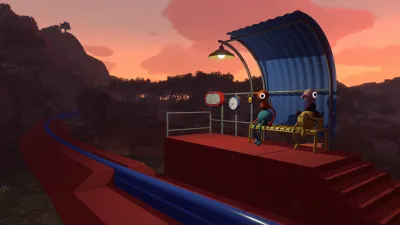
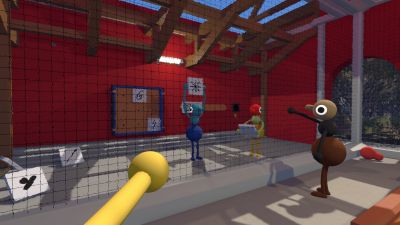
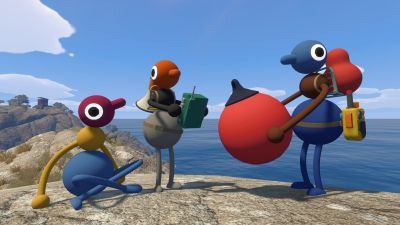
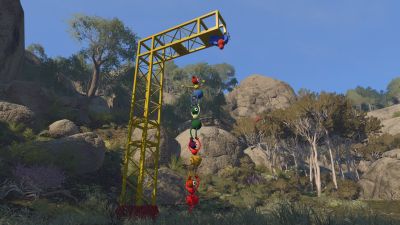
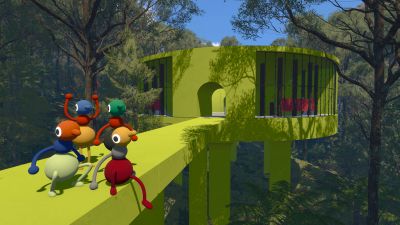
The design philosophy underneath all of that platform logistics is unusually specific for a game in this genre: communication isn't a side feature bolted onto puzzle-solving, it's the entire mechanism the puzzles are built around. Proximity voice chat fades and muffles the further apart players physically stand in the game world, and several puzzles are explicitly built to exploit that — one player might be able to see a solution the others can't, forcing the whole group to close the distance and actually talk through what they're looking at rather than relying on a shared minimap or an objective marker doing the coordination for them.
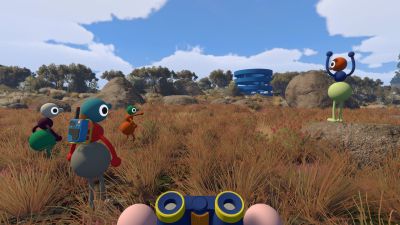
That same design logic extends to the game's stance on external communication: House House built the game to intentionally punish players who hop onto Discord instead of using the in-game systems, since distance, physical barriers, and the proximity chat's audio design are themselves puzzle elements, and bypassing them with an outside voice call quietly strips out half of what a given puzzle is actually testing. Critics singled this out repeatedly as the game's smartest design choice, since it turns a mechanic other party games treat as a technical afterthought into the actual substance of what you're doing session to session, and it's also why puzzles reconfigure themselves depending on whether a session has two players or a full crowd — a small group standing close together plays through a puzzle very differently than eight people spread across a hillside relaying instructions down a human chain.
The game reinforces that philosophy structurally too — there's no online matchmaking to drop into a session with strangers, which at first glance reads as a missing feature but tracks directly with the communication-first design: a puzzle built around trusting a partner's voice and reading their tone under pressure works because you already know that person, and matching random players together would undercut the exact thing the whole system is trying to create. It's a deliberate trade-off rather than an oversight, even if it does mean the game has a real access requirement most party games don't: a pre-existing group willing to actually show up together.
How Critics Scored It, Platform by Platform
The Metacritic breakdown makes the platform story clearer than a single aggregate score would:
- PC: 92, landing in Metacritic's "Universal Acclaim" tier
- PlayStation 5: 88, "Generally Favorable"
- Nintendo Switch 2: 75, still "Generally Favorable" but the clear outlier
Eurogamer handed the game a perfect score, calling it a "funny, exciting, and deeply rewarding multiplayer adventure," while both IGN and GameSpot landed at 9 out of 10, with GameSpot going as far as ranking it among the best co-op games ever made. The Switch 2 version's lower score isn't a design complaint — critics have been consistent that the gap comes down to hardware constraints on the newer, less powerful platform rather than anything wrong with how the game itself was built for it, which is a meaningfully different problem than a rushed or poorly optimized port would represent.
Reviewers who covered the Switch 2 version specifically noted frame rate dips during the busiest moments in larger sessions, when the game has to render more players and more of the surrounding landscape at once, but the same reviewers were consistent in saying the core puzzle design and communication mechanics translate intact even when the visuals are compromised, which is a meaningfully better outcome than a port that loses functionality rather than just resolution or frame rate.
Why Players and Critics Don't Fully Agree
Despite the critical consensus, the player-side reception has landed closer to a mixed 8.1 average, and the sticking point across a lot of that feedback is the price rather than the design. At $19.99 for a game with no single-player mode, no matchmaking, and a structure built entirely around already having a group of people you want to spend an evening walking around with, a meaningful slice of the audience is questioning whether that's a fair ask compared to other games in what's increasingly being called the "friendslop" category — low-stakes, social-first multiplayer experiences built more around hanging out than around traditional objectives or difficulty.
It's a genuinely fair question rather than just online noise: this isn't a game you can meaningfully play solo, there's no way to matchmake into a session with strangers, and the entire pitch depends on already having two to eleven other people both willing and available to commit to a session together, which is a real logistical ask that a lot of potential buyers simply can't guarantee on a regular basis regardless of how good the game turns out to be once that group actually assembles. It's worth separating that from a complaint about quality, though, since almost none of the mixed player feedback disputes that the game plays well once a session actually gets going — the friction shows up earlier, in scheduling four adults' calendars around a game that doesn't work if even one of them can't make it, which is a genre-wide problem for anything built around a fixed group rather than one specific to how House House built this particular game.
Big Walk launched across PC, PS5, and Switch 2 simultaneously with full crossplay and near-universal critical acclaim, led by a 92 on PC and praise for treating proximity-based communication as the actual core mechanic rather than a background feature. The Switch 2 version trails on Metacritic due to hardware limits rather than design flaws, and a meaningful chunk of the player base has pushed back on the $19.99 price for a game with no single-player mode and no matchmaking, framing the debate around value in the emerging "friendslop" genre rather than around the game's actual design quality.

To download the app, you will get links to the Official Website and/or official digital markets.










Trending Games




Latest Reviews




Latest Articles
-
![]() St. Amelia’s Labyrinth of Shadows and Secrets The eerie allure of St. Amelia is never as straightforward as it initially appears. In this unfolding adventure, immersive narratives and challenging tasks entwine to... Read more
St. Amelia’s Labyrinth of Shadows and Secrets The eerie allure of St. Amelia is never as straightforward as it initially appears. In this unfolding adventure, immersive narratives and challenging tasks entwine to... Read more -
![]() Ubisoft's Director's Cut Breathes New Life into Controversial Franchise Amid Studio Shake-Up An upcoming update is stirring interest among fans as Ubisoft plans to breathe new life into a previously underwhelming release. The studio is aiming for... Read more
Ubisoft's Director's Cut Breathes New Life into Controversial Franchise Amid Studio Shake-Up An upcoming update is stirring interest among fans as Ubisoft plans to breathe new life into a previously underwhelming release. The studio is aiming for... Read more -
![]() Fantasy Game Creators Unite: Demanding Rights and Resisting Overreach in Tech Policy This article discusses a recent move by teams behind popular fantasy games to come together as a union, with their initial focus on demanding changes... Read more
Fantasy Game Creators Unite: Demanding Rights and Resisting Overreach in Tech Policy This article discusses a recent move by teams behind popular fantasy games to come together as a union, with their initial focus on demanding changes... Read more -
![]() Unlocking Hidden Mysteries: The Intricate World of Strongboxes in Beast of Reincarnation The world of Beast of Reincarnation unfolds as a sprawling landscape of adventure, mystery, and hidden rewards. Throughout the game, players encounter numerous Strongboxes that... Read more
Unlocking Hidden Mysteries: The Intricate World of Strongboxes in Beast of Reincarnation The world of Beast of Reincarnation unfolds as a sprawling landscape of adventure, mystery, and hidden rewards. Throughout the game, players encounter numerous Strongboxes that... Read more